The case for context engineering in scientific AI

On February 17, 2026, Anthony Kougkas spoke at the monthly meeting of Earth Science Information Partners (ESIP) on context engineering for environmental data systems. His argument, first made at an Illinois Tech seminar six days earlier, was that AI agents in science fail or succeed on the quality of the context they receive, not on the size of the model.
Infrastructure built for a different user
Environmental data systems were designed for human-driven batch workflows. AI agents need something else: real-time, semantic access to archives stored as HDF5, NetCDF and Zarr, which are growing to petabyte scale. Kougkas defined context engineering as "the discipline of building dynamic systems that deliver the right data, metadata, and tools to AI agents at the right time."
The point builds on earlier GRC work on the gap between scientific data and AI. DLIO, a benchmark for the I/O behavior of scientific deep learning applications, won the CCGrid 2021 best paper award. Stimulus (CCGrid 2022) showed that scientific formats such as HDF5 and NetCDF remain incompatible with AI frameworks unless the data is converted by hand. The ESIP talk took the next step and examined the gap between what current storage systems provide and what autonomous agents need.
How context goes wrong
The ESIP talk identified four context failure modes that appear at archive scale: poisoning, rot, clash and overflow. The seminar described the first in detail. In context poisoning, bad data enters an agent workflow and cascades through it until it corrupts the scientific result.
Both talks answered with the same four core strategies for managing context: write, select, compress and isolate. They follow from the definition above: context is delivered by a dynamic system, not written once into a prompt.
From a chatbot to a multi-agent system
At the February 11 computer science doctoral seminar at Illinois Tech, titled "From Storage Optimization to Context Orchestration: Why Your AI Infrastructure is Already Obsolete", Kougkas gave a live demonstration that contrasted a single chatbot with a multi-agent system. The demonstration used orchestrator patterns, meta-prompting and human-in-the-loop design to show the infrastructure that separates a demo from autonomous science that holds up in production. The talk also asked whether the future belongs to general-purpose agents or to domain-specific scientific systems, and mapped open problems in context quality metrics, provenance tracking and evaluation frameworks. In both talks, the stated aim was to amplify scientific intuition, not replace scientists, by automating tedious data orchestration so researchers can focus on discovery.
Where IOWarp fits
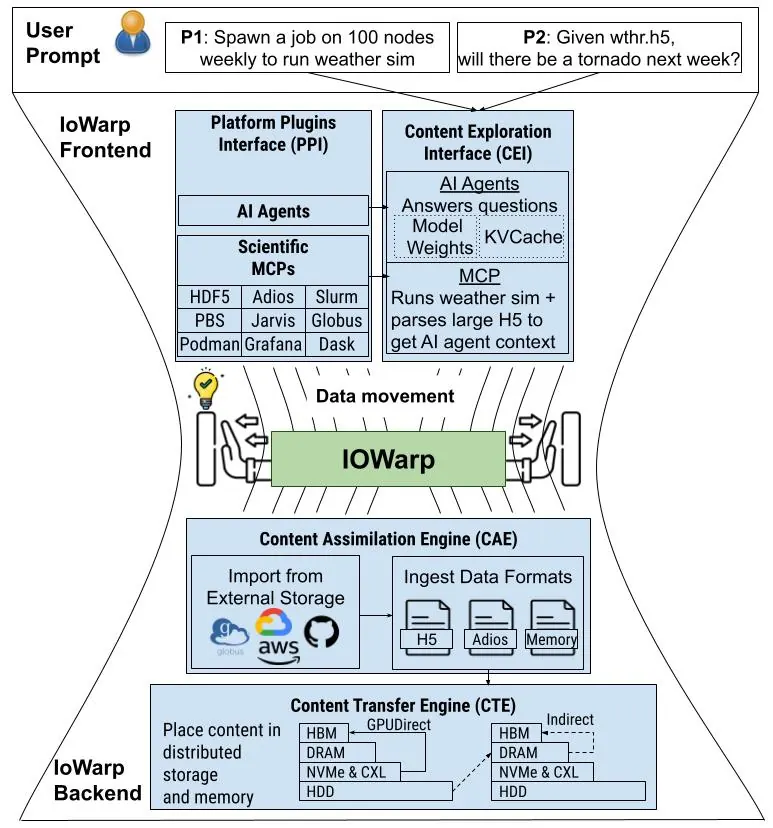
Both talks presented IOWarp, GRC's NSF-funded platform for scientific data, as the systems answer. IOWarp places data across memory and storage tiers and exposes it to agents. Its CLIO Kit component provides Model Context Protocol (MCP) servers for scientific data formats, so an agent can query an HDF5 or NetCDF file through a standard interface instead of a custom conversion script. ESIP published the recording of the session.
Update (May 2026): Kougkas carried the same argument into genomics as a featured keynote speaker at the 7th IFSH High-Throughput Sequencing Symposium, held May 19 and 20, 2026, in Burr Ridge, Illinois, and organized by Illinois Tech's Institute for Food Safety and Health. His talk on May 20, "IOWarp: Intelligent Data Management to Accelerate Food Safety Genomic Research", applied IOWarp to the data handling in genomic analysis.
Learn more
- ESIP recording: Context Engineering for Environmental Data Systems (opens in a new tab)
- Illinois Tech CS doctoral seminar, February 11, 2026 (opens in a new tab)
- 7th IFSH High-Throughput Sequencing Symposium (opens in a new tab)
- IOWarp project and IOWarp on GitHub (opens in a new tab)
- Anthony Kougkas's profile